
Plucky Skunk Train Celebrates 120 Years
By Claudia Smith Hill
Friday, July 01, 2005
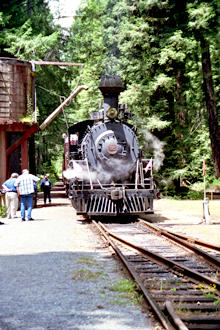 |
| The North Coast's Skunk Train prepares to take on water at Northspur during its 120th anniversary run. Photo by Dick Hill |
The sun shown warm on an excited crowd of folks at the Willits Skunk depot on Saturday morning, June 25. Red coated conductors hurried up and down the tracks and little kids jumped up and down when the engineer sounded his horn.
Greg Schindel of Willits, the now famous Train Singer, joined the Black Bart gang waiting on the platform with visitors from all over California for the big event to start. Finally at 10 a.m., parents gathered their kids and souvenirs and tickets and mounted the steps into the bright orange 1910 coach cars headed for Northspur and the grand celebration of the old redwood train's 120th birthday.
The sturdy diesel locomotive, pulling two vintage coach cars and an open-air observation car built between 1919 and the 1920s, is an old GP-9, manufactured by a division of General Motors and was introduced on this line in 1955. Its 16 cylinders generate 1750 horsepower, which is essential to pull the train over the highest point along the Skunk line.
After traversing a very dark tunnel 790 feet long the train suddenly grinds out at the summit, which is 1740 feet above sea level and reached by an amazing series of twists and switchbacks. The train then carefully descends a three percent grade down into the Noyo River Valley, with 341 curves in only 40 miles of track for the rest of the journey into Northspur.
We pass thought-provoking remnants of life along the line; lives long since ended. A few collapsed cabins in the redwoods at Crowley station attest to a tiny community of railroad employees who worked on the tracks in the early 1900s. Weathered signs mark Clare Mill, Shake City, which was destroyed by a forest fire in the 1950s, and Irmulco station, still a thriving community of residents today. At Big Stump Ranch we stopped to drop off a couple of passengers, and eventually we arrived at Northspur where the steam locomotive had already debarked its passengers from the coast.
A sumptuous barbecue awaited us, chicken and beef over open fires, corn on the cob and other delicious goodies and more than 300 people waited with good humor in line to enjoy the food. The steam engine entertained us with taking on water from the giant water tank while we waited in line. It took 2000 gallons of water to get the steam Skunk from Fort Bragg to Northspur and back.
Steam locomotive No. 45 was placed in service in 1965 and just received its regular certification the day before the celebration. Many of the Willits passengers changed trains and boarded the steam train in Northspur for the journey back to the coast and an overnight stay in Fort Bragg.
The highlight of the Northspur adventure was the driving of the golden spikes by the president and vice president of our hosts Sierra Railroad, the new owners of the Skunk line. The event was a reminder of the golden spike event when Leland Stanford was supposed to drive the spike which connected the Untied States transcontinental railroad on May 10, 1869.
Sierra Railroad President Mike Hart said his company is interested in preserving history and he and the Vice President of the company, Robert Pinoli, kept pretty much to historical accuracy in the driving of two golden spikes at Northspureach of them missed their targets many times just as Leland Stanford missed his target 136 years earlier on completion of the Union Pacific line. It was a great triumph for the Skunk line, however, and both men were pleased with their efforts.
Hart, whose company bought the line in 2003, said the Skunk train is doing very well, although they are working on some innovations, which the expect will bring more visitors for train rides. The railroad operates three runs, a short 90 minute run from Willits to Crowley and back, the diesel engine train from Willits to Northspur and return, and the steam locomotive ride which leaves Fort Bragg, goes to Northspur and returns to the coast.
Founded in 1885 as the California Western Railroad and Navigation Company, the Skunk train was built as a logging railroad. Tracks were gradually extended east as the lumber company reached further into the lush redwood forest for logs. At one time there also were many side spurs running up canyons and creeks. As a convenience to the pioneers of those days, the railroad also provided mail and grocery service to the many logging camps scattered along the line.
Passenger service from Fort Bragg began in 1904 and was extended to Willits in 1911. Then passengers could ride the train to meet a stagecoach at various locations along the line to continue their trip east.
In 1925 the railroad began using a self-propelled rail bus, called a Budd car, to provide passenger and delivery service along the line. Children living in the Noyo canyon rode into Willits to go to school and during the winter months when the road out of Northspur was impassible, families rode the Budd car to Willits and Fort Bragg for doctor's visits, grocery shopping and various other essentials.
The Budd car was nicknamed the "Skunk" by local residents, because the combination of gasoline fumes and smoke from its pot bellied stove was carried up the canyon by the ocean breezes, prompting locals to say you could "smell em before you could see em."
On our modern day Skunk train, the genial engineer on our Willits run was Jim Baskin, a great grandson of the Baskin ice cream family. The conductors were warm and welcoming, patiently answering questions while attending to their important job of organizing and managing the train, and the executives of the Sierra Railroad Company were having just as good a time as their guests.
On the ride home, children gathered around the Train Singer in the observation car, singing merry tunes along with Greg and dancing to his unique guitar and harmonica renditions of folk music and children's train songs, adding an enchanting conclusion to a magical ride through the redwoods. As the train rounded curves the "singing rails" joined the music of the children and many of their parents.
The scenery was something out of a travel magazinerolling hills with waving grass in the Willits valley, a flight of wild turkeys, and a pasture of sheep and their tiny lambs. Rising into the mountains it was a joy to see the buckeye trees showing off their candle blossoms, drifts of blossoming blackberry bushes, blooming bay laurel trees and tan oaks hanging over elderberry bushes in blossom, with wildflowers still painting the mossy edges of the Noyo River and various ferny springs and creeks.
Rising in elevation, the handsome redwoods took over the scene, with one tree purported to be 700 years old dominating a younger stand of mixed fir, pine and redwood trees. In one spot they shaded a tiny red bunkhouse, a portable building which originally served as housing for logging and railroad camp workers and is now used for railroad storage.
The Skunk's birthday was a day to remember and the new owners of the Sierra Railroad Company are to be congratulated on having preserved a vital link to Mendocino County's past. Not only is the Skunk train ride a delightful experience, it contributes to the economy of Willits, Fort Bragg and Ukiah and is being greeted once again with enthusiasm by local residents as well as visitors. |